If you’ve ever wondered, “How many houses am I supposed to see before I know?”- congratulations, mathematicians have wondered about this too. Although, admittedly, they

Dated: August 24 2026
Views: 82
If you’ve ever wondered, “How many houses am I supposed to see before I know?”- congratulations, mathematicians have wondered about this too. Although, admittedly, they probably weren’t standing in a kitchen debating whether they could live with that backsplash.
There is a mathematical concept called the optimal stopping problem: essentially, when do you stop looking at your options and commit?
One famous version is the secretary problem. Imagine you have a fixed number of candidates, you meet them one at a time, and once you pass on one, they’re gone. Your goal is to maximize your chances of choosing the very best.
The surprisingly elegant answer is to spend roughly the first 37% of your search looking and learning, then start seriously considering the next option that beats everything you’ve seen before.
For the mathematically inclined:
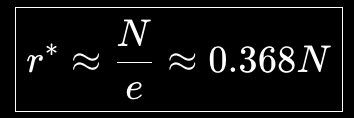
Where:
Let’s translate that into a fairly normal home search. Say you’re giving yourself six months, touring homes about twice a month and seeing two or three houses each time. That’s somewhere around 24–36 homes before your self-imposed deadline.
According to the math, the first 9–13 homes — roughly your first two months — are your education. You’re figuring out what your budget actually buys, which neighborhoods feel right, which “must-haves” mysteriously stop being must-haves, and how many bad flips it takes before you develop a visceral reaction to gray LVP.
Then the strategy changes.
After that initial calibration period, the classical rule is wonderfully ruthless:

Where:
Translation: if the next house is better than everything you saw during your learning period, take it.
There is considerably more math behind this. For those who enjoy such things, the famous 37% isn't an arbitrary number: it comes from maximizing the probability of selecting the single best option from a randomly ordered set. As the number of choices gets large, both the optimal observation period and, rather delightfully, your maximum probability of actually picking the very best option approach (1/e), or about 36.8%.
Except there’s one problem with applying a decades-old math problem to buying a house in 2026: you’ve probably been shopping long before you started shopping.
By the time most buyers walk into their first showing, they’ve already spent months scrolling through Zillow, saving homes on Instagram, watching neighborhood tours, sending listings to their spouse at inappropriate hours, and developing surprisingly strong opinions about things they previously didn’t know existed. Fluted cabinets, anyone?
That online browsing counts for something. It may not replace walking through a house (photos have never conveyed an inexplicably low ceiling particularly well), but it helps establish the same thing those first few showings do: a benchmark.
Which means the 37% rule is probably better understood as a learning period than a literal number of houses. Once you understand your market, your budget and your own preferences, the equation changes. If a house comes along that’s better than everything you’ve seriously considered so far, statistically speaking, you have a pretty good reason to stop wondering whether something even better might appear next weekend.
And if you’ve been following the market for a year, toured nine houses, rejected 400 more from your phone, and suddenly walk into one that nails your criteria?
You probably don’t need house number ten to tell you what you already know.
Now, before anyone calls their realtor and says, “We cannot make an offer yet; we have only reached house number 11,” there are some problems with applying this literally.
Real estate is not a controlled mathematical experiment. A house you reject may still be available next week. Another buyer may appear tomorrow. Interest rates move. Prices change. Inventory is seasonal. And, most importantly, you probably aren't trying to identify the mathematically best house out of every house you could possibly have seen.
You're trying to find a home that works exceptionally well for your life.
But I do think the math captures something buyers intuitively struggle with: you need to look long enough to know what good looks like, but not so long that looking becomes the goal.
There is value in those first weekends of open houses, awkward layouts, questionable renovations and houses that looked much better in the photos. They create your benchmark.
But once you have that benchmark, don't let the theoretical existence of a better house keep you from buying a great one.
And if house number four somehow nails the location, the light, the layout, the backyard, the budget and that one oddly specific thing you swore you wouldn't compromise on?
Forget the 37%.
Buy the house.

Ola is a Dallas based real estate professional known in the local community for her passion for architecture, thoughtful design, and dedication to her clients. Originally from Belarus, she has travele....
If you’ve ever wondered, “How many houses am I supposed to see before I know?”- congratulations, mathematicians have wondered about this too. Although, admittedly, they
Kristyn Fuston | eXp RealtyExpect Better, Experience Luxury.That Builder Mortgage Rate Looks REALLY Good… But Is It Actually the Better Deal?You see a new-construction ad offering a rate that
Is Dallas a great architecture city? Ask quickly, and many people might say no. Compared with the Art Deco grandeur of New York, the architectural mythology of Chicago, the Case Study houses of
You may have seen headlines claiming big investors are buying up all the homes. If you’re a buyer facing tough competition, that idea can feel believable. But while the narrative is loud, the
 © 2026 North Texas Real Estate Information Systems, Inc. All rights reserved. Disclaimer: All information deemed reliable but not guaranteed and should be independently verified. All properties are subject to prior sale, change or withdrawal. Neither listing broker(s) nor eXp Realty in Metrotex shall be responsible for any typographical errors, misinformation, misprints and shall be held totally harmless. The database information herein is provided from and copyrighted by the North Texas Real
Estate Information Systems, Inc. NTREIS data may not be reproduced or redistributed and is only for people viewing this site. All information provided is deemed reliable but is not guaranteed and should be independently verified. The advertisements herein are merely indications to bid and are not offers to sell which may be accepted. All properties are subject to prior sale or withdrawal. All rights are reserved by copyright.
Data last updated: September 23, 2026 7:32 PM UTC
Show More...
© 2026 North Texas Real Estate Information Systems, Inc. All rights reserved. Disclaimer: All information deemed reliable but not guaranteed and should be independently verified. All properties are subject to prior sale, change or withdrawal. Neither listing broker(s) nor eXp Realty in Metrotex shall be responsible for any typographical errors, misinformation, misprints and shall be held totally harmless. The database information herein is provided from and copyrighted by the North Texas Real
Estate Information Systems, Inc. NTREIS data may not be reproduced or redistributed and is only for people viewing this site. All information provided is deemed reliable but is not guaranteed and should be independently verified. The advertisements herein are merely indications to bid and are not offers to sell which may be accepted. All properties are subject to prior sale or withdrawal. All rights are reserved by copyright.
Data last updated: September 23, 2026 7:32 PM UTC
Show More...
